

🌱 The Psychology of Silent Money: How Invisible Small Costs Shape Your Financial Future
Discover how emotional spending impacts your financial health and learn practical techniques to control impulses, build awareness, and create a more conscious relationship with money — a unique approach that can boost your long-term financial stability.
11/26/20253 min read
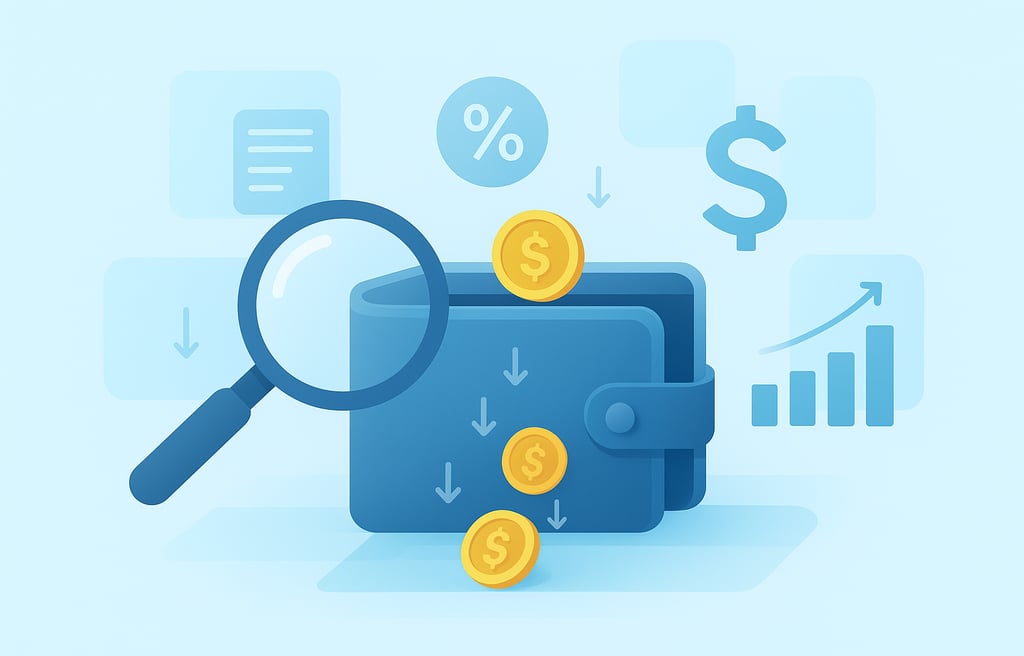
When people talk about financial education, most immediately think of big decisions: investments, new income streams, debt renegotiation, or drastic lifestyle changes. But there is a silent — and rarely discussed — factor that profoundly impacts anyone’s financial stability: invisible costs.
These costs don’t appear clearly in budgeting apps, are barely noticed throughout the month, and are almost never discussed in financial conversations. Yet, they are one of the biggest reasons why many people fail to save, invest, or build long-term financial security.
In this expanded guide, you’ll understand how invisible costs arise, how they affect your brain, how they quietly sabotage your financial progress, and — most importantly — how to eliminate them effectively.
🔍 1. What Are Invisible Costs?
Invisible costs are small expenses or financial leaks that go unnoticed because they:
seem insignificant on their own
are not tracked
happen automatically
occur by distraction
repeat without being perceived
Common examples include:
automatic bank fees
late-payment charges of just a few dollars
forgotten subscriptions
habitual purchases (e.g., daily coffee)
small waste like unused apps, food or energy
hidden service fees
convenience-based price rounding on apps
loss of discounts due to lack of attention
Individually, these expenses look harmless.
But together, they create a financial drain.
🧠 2. Why Does the Brain Ignore These Costs?
(Applied financial psychology)
Our brain evolved to deal with immediate threats — not long-term micro-losses. Behavioral psychology explains this through three major cognitive patterns:
✔ Complexity Avoidance
Your brain prefers shortcuts. If a cost feels too small to calculate, it’s ignored.
✔ Minimum-Impact Illusion
We believe “$1 or $5 won’t make a difference.”
But we forget that $5 a day equals $150 a month.
✔ Decision Fatigue
The more decisions you make daily, the more likely your brain will choose autopilot spending.
Combined, these factors create an invisible enemy.
💥 3. The Real Impact: How Losing $5–$20 Turns Into Thousands
Let’s assume you lose just $5 per day or $20 per week to invisible costs.
This becomes:
$80 per month
$960 per year
$9,600 in 10 years
Over $13,800 if those small values were invested
That amount could:
build your emergency fund
finance a full vacation
clear minor debts
grow long-term investments
Tiny leaks create massive long-term losses.
🧰 4. The 6 Types of Invisible Costs That Hurt People the Most
1️⃣ Automatic Costs
Subscriptions, renewals, unnoticed service charges.
2️⃣ Emotional Costs
Purchases triggered by stress, exhaustion or frustration.
3️⃣ Habit-Based Costs
Daily repetitive spending that becomes a routine.
4️⃣ Bureaucratic Costs
Late fees, penalties, maintenance fees.
5️⃣ Tech-Driven Costs
App rounding, convenience fees, microtransactions.
6️⃣ Forgetfulness Costs
Unused subscriptions, expired discounts, missed payments.
🧭 5. How to Identify & Eliminate Invisible Costs (Practical System)
Here’s a simple but powerful method few people use:
✔ Step 1: 7-Day Financial Audit
Write down everything.
Every cent.
This reveals what is hiding in the shadows.
✔ Step 2: Subscription Sweep
Apply the 3-filter test:
Do I use it?
Do I need it?
Is it worth the price?
If it fails 2 out of 3, cancel it.
✔ Step 3: Check Hidden Bank Fees
Switch to banks with zero-cost accounts.
✔ Step 4: Break Automatic Habits
Review one habit per month and adjust it intentionally.
✔ Step 5: Add Psychological Barriers
remove cards from apps
enable spending alerts
disable auto-purchases
impose a “pause” before buying
✔ Step 6: Transform Savings Into Investments
Every eliminated invisible cost → automatically invested.
This multiplies the impact.
🔄 6. The 30-Day Rule To Prevent Future Invisible Spending
Function: break autopilot spending.
How it works:
If a non-essential item costs under $20–$30, wait 30 days.
Studies show 85% of impulse desires disappear before the deadline.
🧩 7. The Conscious-Money Mindset
Eliminating invisible costs requires:
attention
discipline
self-awareness
consistent monitoring
responsible consumption
The more you train your mind to “see” money, the less it disappears without explanation.
🏁 Conclusion: Real Wealth Lives in the Details
Most people lose money silently, without realizing it.
But true financial stability is built on the opposite: seeing what others ignore.
Invisible costs are small only in the beginning.
Over time, they become the reason why:
you don’t save
you don’t invest
you don’t grow
you live under pressure
When you eliminate these hidden leaks, you regain control of your money, recover your power to invest, and transform your financial future.
The money you lose without noticing is the same money that could build your freedom.
Start today.
Your future self will thank you. 🌱💰